
Fusion Diagnostics
Plasma diagnostics from physics-based design to manufacturing and lifetime support — delivered as standalone systems or as part of our Modular Diagnostics Platform (MDP) for next-generation MCF devices and future Fusion Power Plants.
Fusion plasma is a complex, non-linear, and turbulent system that requires continuous monitoring and active control. Commercial fusion demands diagnostics that work in a high-energy neutron environment and are standardized, off-the-shelf, and fast-replaceable — ensuring stable supply chains, controlled costs, and continuous operation.
At Next Step Fusion, we are building an entire diagnostics business to support fusion builders with solutions that enable physics validation, plasma control, device safety, and the licensing case. Everything is based on world-class science, backed by tools for the design, engineering, and optimization of diagnostics, and provided as industrial solutions with lifetime support.
What We Offer
Diagnostics feasibility study
We start from the measurements: what must be measured on your device, and why, and whether microwave diagnostics are applicable to your device and parameters. Engaging early lets us design diagnostics for cost efficiency and operational simplicity, feed port and access needs back into the device design, and build plasma control and device safety in from the start.
Modular Diagnostics Platform (MDP)
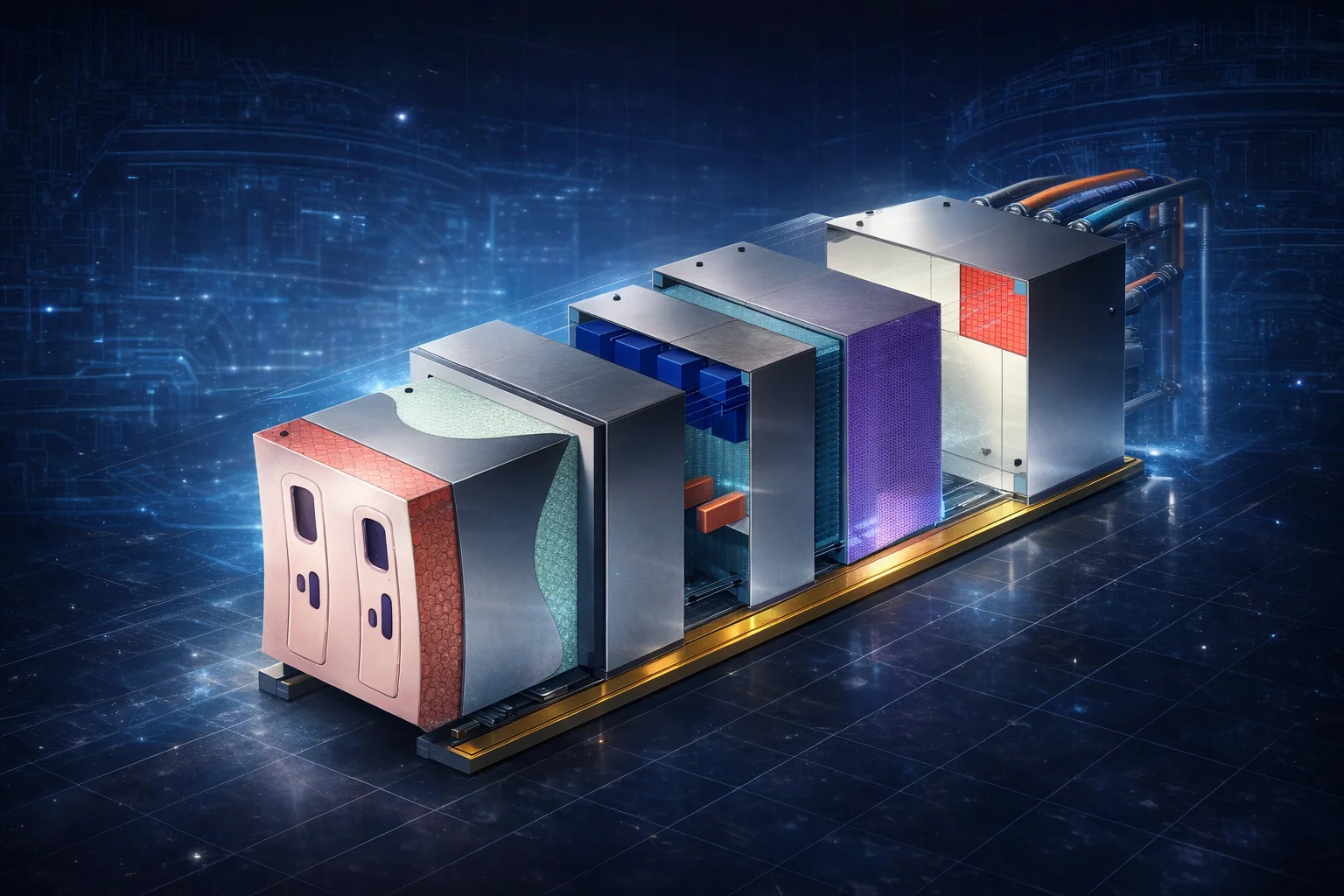
Every diagnostic we develop is available standalone — or as part of the MDP, our integrated I&C solution: a unified, standardized set of plasma diagnostics, minimalistic yet sufficient for stable control of a fusion plant. It combines a hot-swappable port-plug hardware unit, data acquisition (VIDA), real-time plasma state reconstruction, and a supply chain built on standardized, fast-replaceable components.
Microwave diagnostics
Non-perturbative, with no in-vessel calibration targets, and reliable in high magnetic field and neutron environments. Our on-chip ECE radiometer delivers localized, absolute electron temperature profiles in real time; our multi-band, dual-polarization profile reflectometer measures electron density profiles from small-aperture antennas with no large ports or beam lines. Both share a single port plug.
Magnetic diagnostics
THOR: a graphene-on-silicon-carbide Hall sensor measuring absolute magnetic field instantaneously — no time integration, no drift over long pulses. It offers ~75 V/AT sensitivity (75–80× above metal Hall sensors), stable operation to 770 K, self-healing of neutron damage through thermal annealing, and a 1.4 mm × 1.4 mm footprint. Now maturing from TRL 4 to TRL 6.
Neutron diagnostics
A miniature, fully passive graphene-on-SiC dosimeter for spatially resolved fast-neutron fluence measurement — no power or cabling during exposure, read out non-destructively by Raman spectroscopy afterward. Demonstrated up to 6.5×10¹⁸ n/cm2, with a built-in reference region for self-verified fluence estimation, for reactor qualification and component lifetime assessment.
Other diagnostics
Need a diagnostic outside our current portfolio? Collective Thomson scattering and a radial interferometer-polarimeter are on our roadmap, and our physics-enabled design approach — synthetic diagnostics, optimization tools, and multi-machine measurement experience — applies to a wide range of measurement systems. Third-party sensors integrate via standardized interfaces.
Diagnostics design software
Synthetic diagnostics built on our integrated modeling framework simulate the expected signals for your device and scenarios, so sightlines, sensor placement, and measurement ranges are optimized before any hardware is built. For each diagnostic, frequency plans, channel counts, polarizations, antennas, and port geometry follow from your magnetic field, density, and access constraints.
Building a New Device?
Talk to the MDP team early — the best time to think about diagnostics is at the design stage, not after construction.
Get in touch