Plasma Control

From a controller training and testing environment to high-precision controllers that combine conventional robustness with AI/ML flexibility — plus integrated diagnostics and control projects that fully enable plasma control and device safety.

Plasma Control Challenge

Plasma is an inherently unstable, high-dimensional, and rapidly evolving system. Controlling it in real time — across the full discharge lifecycle, from initiation through flat-top and ramp-down — demands controllers that are fast, robust, and deeply integrated with the physics of the device.

Next-generation fusion devices must operate at higher performance, with tighter constraints on plasma shape, position, and stability, while maintaining strict interface contracts with safety and supervisory systems. Compounding this, available diagnostic power on these devices will be limited — reducing the number and quality of real-time measurements, and placing even greater demands on control systems to remain robust under partial observability.

Next-generation tokamaks and future fusion power plants (FPPs) require industrial-grade plasma control solutions that build on the proven conventional control experience accumulated at today's research devices — and extend it with modern approaches capable of managing the full complexity of a commercial plant: digital twin integration, multi-objective optimization across energy, stability, and operational goals, and adaptive control that can evolve with the machine over its lifetime.

Plasma Control Solutions

Solutions

We combine physics insight, modern machine learning, and real-device deployment experience to build control systems that work in practice — not just in simulation. From a controller development and testing environment to a custom plasma control system for your device.

Discharge scenario development

We develop and optimize discharge scenarios tailored to the physics and operational goals of your device — covering initiation, ramp-up, flat-top, and ramp-down phases, and taking into account actuator limits, stability boundaries, and control objectives.

Controller training and testing environment

A software environment for developing, training, and testing controllers of plasma shape, position, and other parameters — providing standardized interfaces to device models, actuator simulators, and real-time diagnostic streams for software- and hardware-in-the-loop validation before live deployment. Available via the Fusion Twin Platform's public web API.

High-precision hybrid controllers

We design and deliver controllers that combine the robustness of conventional control with the flexibility of AI/ML — multi-objective optimization across energy, stability, and operational goals, clean simulation-based training in the NSFsim environment, and transfer pipelines for moving trained policies to real PCS hardware. Demonstrated live at DIII-D, with full support through integration, commissioning, and operation.
Integrated diagnostics and control

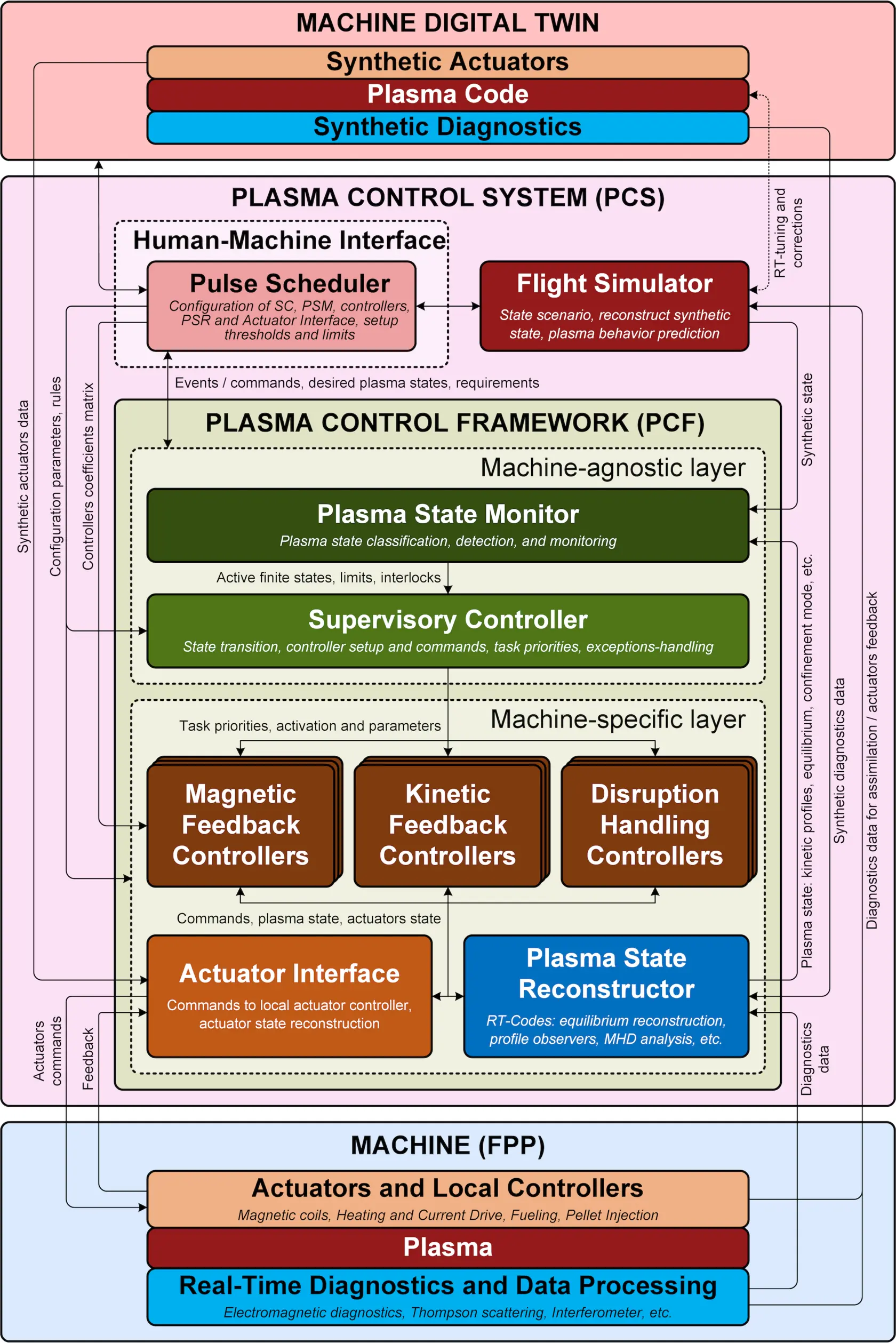
Projects that combine measurements, actuators, and control into one coherent system — fully enabling plasma control and device safety. Building on our diagnostics development work, we design the full loop from real-time plasma state reconstruction through control decisions to actuator commands, with safety and supervisory interfaces built in from the start.

Relevant Reading

From reconstruction-free RL controllers running live at DIII-D to formal interface contracts for AI in high-stakes physical systems — our work spans the full plasma control stack.

Blog

The Brain of Fusion Power Plants

An overview of the hierarchical control system architecture for fusion power plants — from the plasma control layer through plant control, safety systems, and supervisory coordination — and the engineering challenges each layer presents.

Paper

Reconstruction-free magnetic control of DIII-D plasma with deep reinforcement learning

Developed with the DIII-D National Fusion Facility — a reconstruction-free deep reinforcement learning controller for magnetic plasma control, deployed and tested on the live tokamak.

Paper

Robustness by design: Interface contracts for AI control in high-stakes physical systems

Formal interface contracts for AI control in high-stakes physical systems, establishing verifiable safety and robustness guarantees for plasma control deployments.

Blog

How to Control Plasma in a Fusion Power Plant?

An in-depth look at the plasma-state-oriented control architecture for future FPPs — covering the plasma state machine, real-time data assimilation, predictive modeling, and coordinated actuation to keep plasma in desired operating states.

Poster

Design and implementation of a reinforcement learning-based plasma shape controller at DIII-D

Designed and implemented with the DIII-D National Fusion Facility — a reinforcement learning-based plasma shape controller, demonstrated on the live device.

Poster

Developing a state-oriented plasma control system

A state-oriented plasma control system integrating physics-based modeling and ML-driven decision making for next-generation fusion devices.

Blog

Controlling plasma temperature and safety factor with gyrotrons using reinforcement learning

Collaboration with the DIII-D National Fusion Facility — training a reinforcement learning agent to control plasma temperature and safety factor using the ECRH gyrotron system.

See the publications page to learn more about our research and work.

Building a New Fusion Device?

Plasma control is most effective when developed alongside simulations and diagnostics — we offer all three. Talk to us.

Get in touch