Profile Reflectometer
ne profiles and plasma position from small antennas: no large ports, no lasers.

What it is
A profile reflectometer launches a frequency-swept microwave beam into the plasma. Each frequency reflects at the cutoff layer set by the local electron density and magnetic field, and the round-trip delay locates that layer, so sweeping the band yields the electron density profile. Non-perturbative, with no in-vessel calibration targets, no large ports, and no lasers: a robust, real-time density diagnostic for next-gen MCF devices and future FPPs. On-chip modules developed by UC Davis are the path to radiation-tolerant units.
What you get
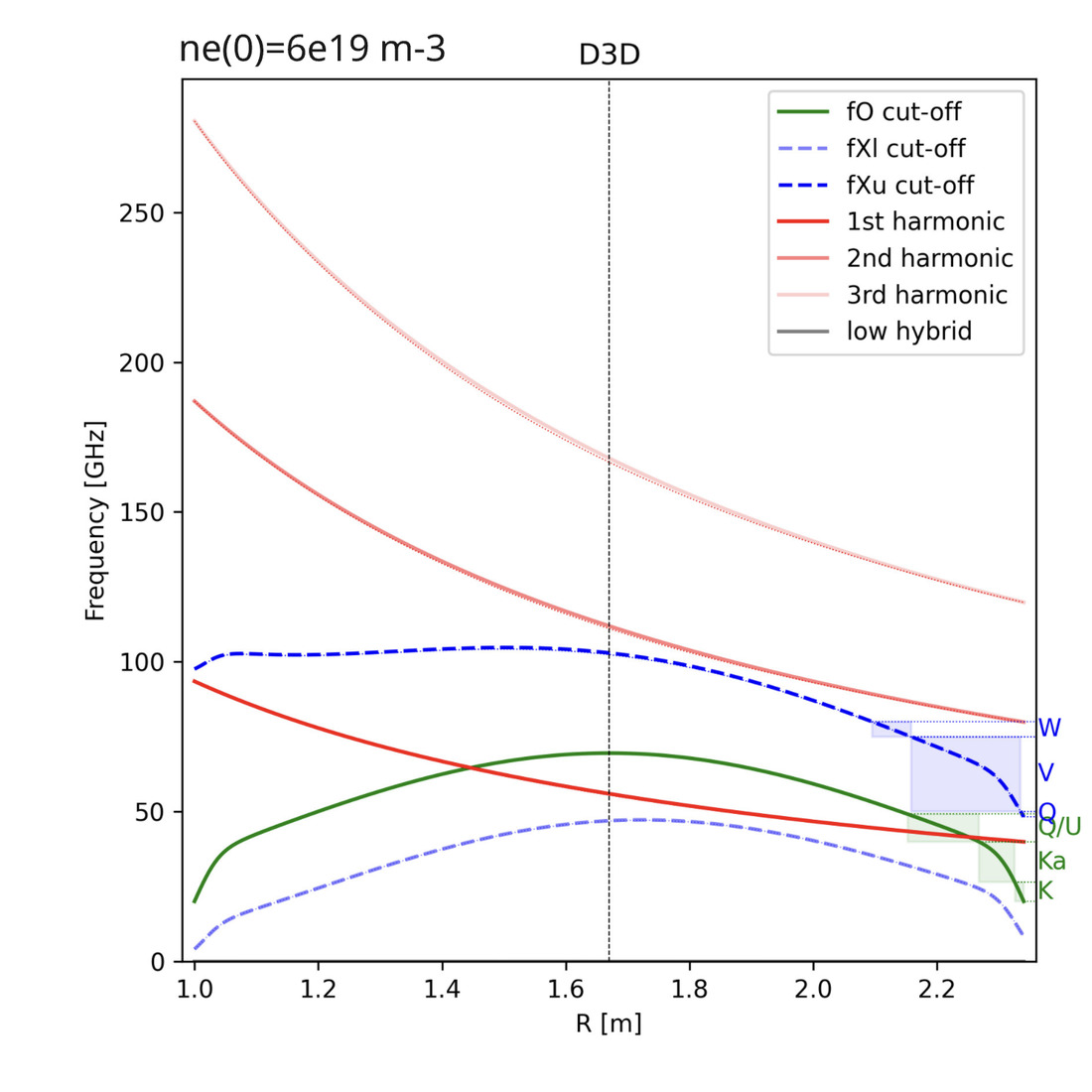
- O-mode K/Ka (18–40 GHz) and X-mode Q/V (33–75 GHz) in one compact front end
- Full-band sweep in ~20 µs, faster than turbulent density fluctuations
- ~0.5 cm spatial resolution; transients such as ELM crashes and pellets resolved
- Phase-locked oscillators and hardware IQ detection: robust at low signal-to-noise
- Physics-informed reconstruction of the full profile where field and density block reflectometry
How it works
We derive the frequency plan, polarizations, antennas, and port geometry from your field, density, and access constraints with our synthetic diagnostics and design tools (SynthDia, TRAVIS ray tracing). Where high fields and densities in next-gen MCF devices and future FPPs leave part of the profile unmeasurable, we are developing physics-informed neural networks to reconstruct the full profile in real time.
Proof
The prototype passed its DIII-D physics validation review in 2026 as part of a joint ECE and reflectometer port-plug unit for TCV and DIII-D, and restores a profile reflectometry capability at DIII-D. Plasma tests are planned on TCV in early 2027 and on DIII-D in spring 2027. Our team brings multi-band reflectometry experience from JET, EAST, DIII-D, ASDEX Upgrade, and ITER. Confinement-state classification with a profile reflectometer for FPPs is published in Nuclear Fusion with UC San Diego and UCLA.