ECE Radiometer
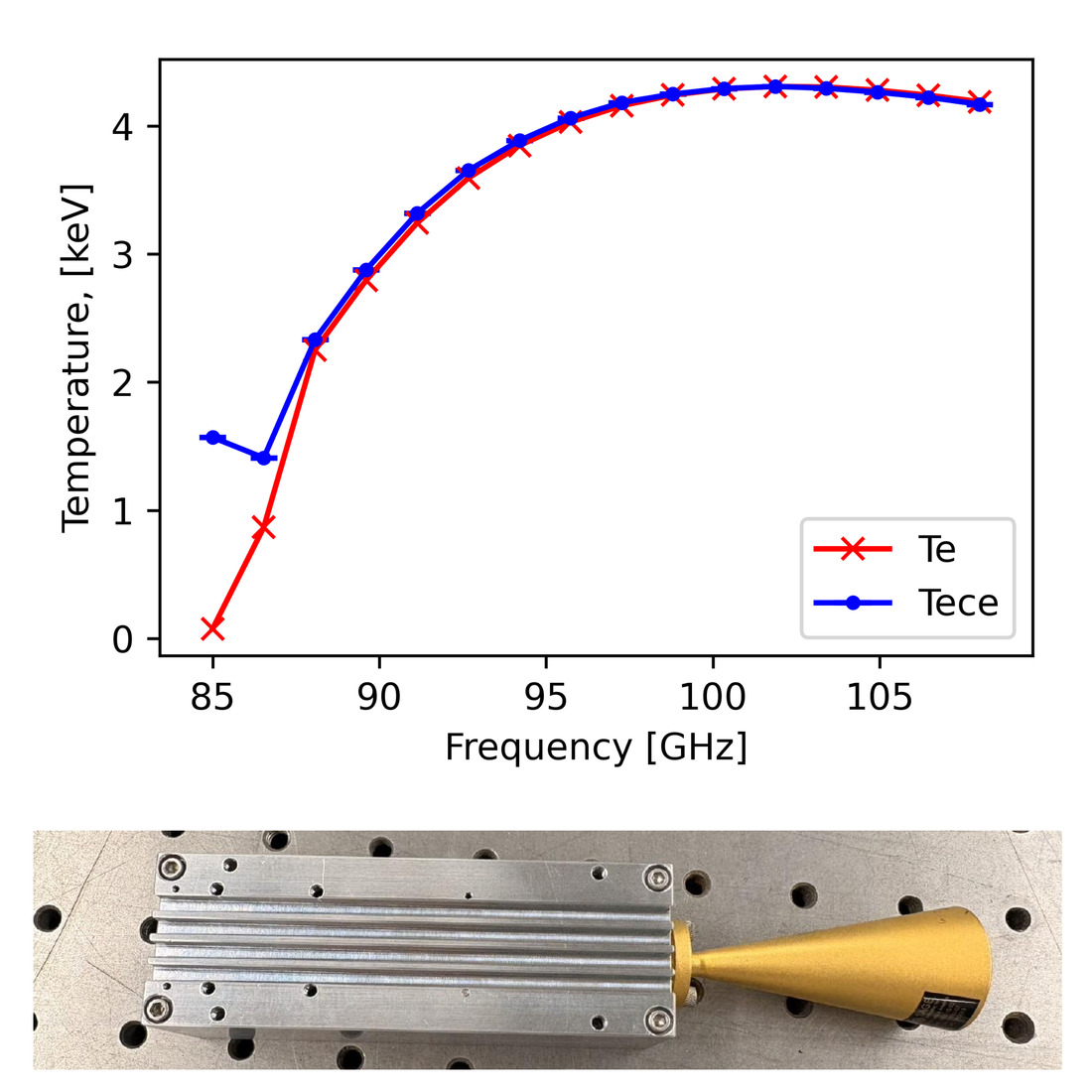
Absolute Te profiles measured and reconstructed in real time on a system‑on‑chip backend.

What it is
Electron cyclotron emission (ECE) radiometry is the workhorse electron temperature diagnostic of MCF devices: electrons emit at harmonics of the cyclotron frequency, so each received frequency maps to a known radius. A calibrated radiometer delivers localized, absolute temperature profiles in real time, ready for plasma control: non-perturbative, with no in-vessel calibration targets, and reliable in high magnetic field and neutron environments. Our backend is a millimeter-wave system-on-chip developed by UC Davis and proven on DIII-D.
What you get
- Absolute Te profiles at 100 µs resolution, stand-alone calibration
- On-chip backend: over 30 dB gain, 0.1 nW detectable, 120 channels in one rack
- Chip family from 50 to 220 GHz for devices up to 6 T; radiation-hard GaN tested
- Physics-informed reconstruction of the full profile where field and density block ECE
- Standalone, or in one Modular Diagnostics Platform port plug with our reflectometer
How it works
We derive the frequency plan, channels, antennas, and port geometry from your field, density, and access constraints with our synthetic diagnostics and design tools (SynthDia, TRAVIS ray tracing). Where high fields and densities in next-gen MCF devices and future FPPs leave part of the profile unmeasurable, we are developing physics-informed neural networks to reconstruct the full profile in real time.
Proof
The on-chip backend by UC Davis runs the ECE imaging system on DIII-D, maintenance-free for seven years. We are developing a prototype ECE radiometer and profile reflectometer in one port-plug unit, to be tested on TCV in early 2027 and on DIII-D in spring 2027, including Versatile Integrated Data Acquisition software and physics-informed neural networks for real-time Te and ne profile reconstruction. The prototype passed its DIII-D physics validation review in 2026, and the concept was presented at the International Reflectometry Workshop and the International Conference on Frontiers in Diagnostic Technologies.