Integrated Modeling

Simulations, design, and engineering for MCF devices — with a focus on tokamaks. Our integrated modeling framework delivers consistent, end-to-end physics calculations across devices ranging from small university tokamaks to ITER-scale systems and industrial pilot plants.

NSFsim and the Framework

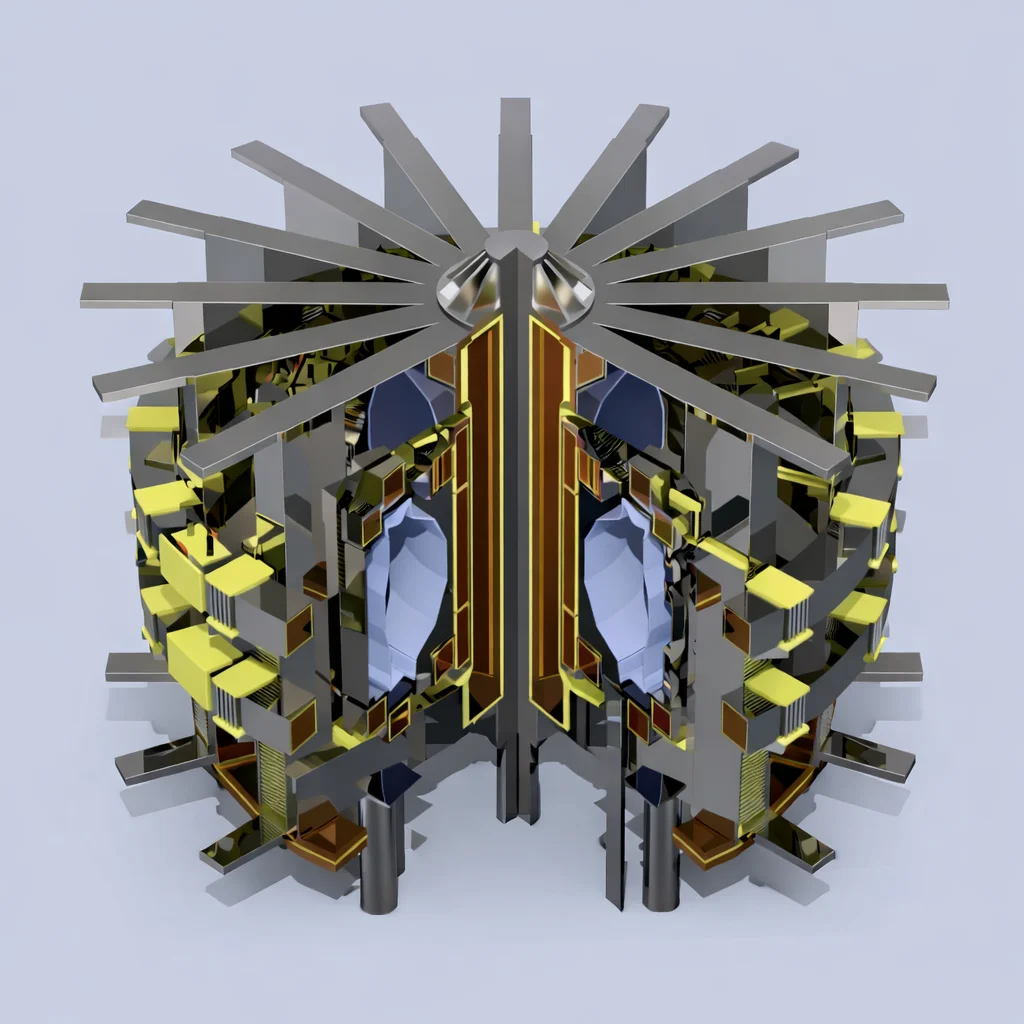
NSFsim is an IMAS-compatible advanced Grad-Shafranov code for 1.5D axisymmetric tokamak plasma simulation. It supports time-dependent transport modeling with free-boundary evolution in external magnetic fields, and builds a tokamak digital replica from the device's magnetic system and conducting structure characteristics.

Capabilities include direct, inverse, and plasma-free calculations; discharge scenario development from a prescribed plasma trajectory; breakdown and burn-through modeling, so scenarios can be simulated before the plasma exists; disruption and VDE simulation resolving toroidal vessel currents through the thermal and current quench; equilibrium reconstruction with the EdFIT module; and synthetic diagnostics. NSFsim has been verified many times and validated against other simulation codes and experimental data from many tokamaks.

NSFsim is available on the Fusion Twin Platform, https://fusiontwin.io, for DIII-D, ISTTOK, NSF NTT, SMART, and other tokamaks, with a public web API and Python, C++, and MATLAB/Simulink interfaces.

NSFsim sits at the core of an integrated framework coupled with TRAVIS (ECRH/ECCD ray-tracing), ASCOT5 (NBI and fast-particle physics), TGLF (turbulent transport), and MISHKA (neural network surrogate for the pedestal), enabling validated end-to-end predictive simulations across the full tokamak lifecycle. Under development: 3D currents in conducting structures, a dedicated stellarator module, p-¹¹B aneutronic reaction modeling, and a hierarchy of scrape-off-layer models.

Download brief (PDF)

Tokamak Integrated Modeling

Services

  • Tokamak physics, design, and operation. Expert support across all phases of tokamak conceptual design, engineering integration, commissioning, and experimental operation.
  • Integrated modeling. Development and deployment of own integrated modeling framework that couples 2D Grad-Shafranov and 1D transport solver with first principle transport models, heating and current drive, scrape-off-layer and divertor plasma, and MHD, enabling multi-physics, time-dependent scenario analysis with consistent inputs and outputs across codes.
  • Disruption modeling (including 3D). Simulation of plasma disruptions and other off-normal fast events, including three-dimensional effects relevant for runaway electrons, halo currents, electromagnetic loads, and mitigation strategy assessment.
  • SOL, divertor, and plasma-material interaction modeling. Simulation of edge plasma phenomena, divertor physics, and plasma-wall interaction, with particular emphasis on liquid lithium plasma-facing components.
  • Control-oriented modeling and software-in-the-loop infrastructure. Development of physics-based models and reduced-order representations exposed via Python and web API to support software-in-the-loop validation of plasma controllers.
  • Machine learning for physics acceleration and control. Application of modern machine learning methods to surrogate modeling of expensive physics codes, disruption prediction and classification, control policy learning and optimization, data-driven augmentation of transport and edge models, with tight coupling to physics-based simulations for interpretability and robustness.

Tokamak Design

Project vision and scope clarification

Feasibility study and pre-conceptual design

Conceptual design and engineering

Specialized Fusion Software

Our team combines experienced plasma scientists with professional software developers and machine learning engineers — building production-grade tools we use ourselves every day. For our work in tokamak simulation and design, plasma control, and diagnostics, we carefully select, license, and integrate the best available fusion codes. When something is missing or not good enough, we develop it ourselves — backed by our in-house physics team and collaborators from leading scientific organizations worldwide.

Online simulation platform

NSFsim simulations of DIII-D, ISTTOK, NSF NTT, SMART, and other tokamaks are available to the fusion community on the Fusion Twin Platform — a web service for running tokamak simulations and managing fusion data in the cloud.
Learn more

Public web API

The Fusion Twin Platform provides a public web API for running NSFsim simulations, developing and testing controllers, building automated pipelines, and more. Examples in Python and MATLAB are available on GitHub.
Learn more

Fusion data viewer

A free and open-source web application for exploring and visualizing fusion data stored in HDF5 files — with tree filtering, dataset inspection, and customizable dashboards for data analysis.
Learn more

Surrogate models and physics acceleration

Physics-informed neural networks trained on integrated modeling ensembles to replace expensive physics codes with fast, accurate surrogates — enabling real-time inference, rapid scenario screening, and uncertainty quantification at scales impractical with first-principles simulations.

Open Source

We believe open tools strengthen the fusion community. Below are our publicly available repositories — free to use, fork, and contribute to.

Fusion Data Viewer

A backendless progressive web application for exploring and visualizing fusion data stored in HDF5 files—with tree filtering, dataset inspection, and customizable dashboards.
GitHub repository

Tokamak Replica Builder

A visual editor for drawing and configuring poloidal cross-sections of tokamak replicas for simulation. Available as a standalone web app and on fusiontwin.io.
GitHub repository

SOL Box Model

Reduced-physics 0D model of the tokamak Scrape-Off Layer (SOL). Given core power and particle fluxes plus magnetic geometry, it returns upstream (outer midplane, OMP) and divertor target plasma conditions.
GitHub repository

More coming soon

Follow us on GitHub for updates and new open source releases from the Next Step Fusion team. If you have any questions, we are always happy to discuss!
GitHub repository

Relevant Reading

We use NSFsim and the framework around it for a wide variety of tasks, including tokamak feasibility study and design, solving difficult optimization and prediction problems, developing conventional and training ML-based real-time controllers of plasma shape, position, and other parameters, including multi-objective optimization of control.

Blog

NSFsim: What's the Novelty in Our Tokamak Simulator

The current state of NSFsim and its roadmap — shared-memory coupling to TRAVIS and ASCOT5, an EPED-like pedestal workflow with the KARHU neural network, virtual stabilization for controller training, and switching between free- and fixed-boundary calculations.

Blog

Model Verification Using NSFsim: Plasma-free (Vacuum) Calculations

Collaboration with the CREATE team (University of Naples Federico II) on verifying NSFsim against their validated digital replica of the EAST tokamak using plasma-free vacuum shots.

Blog

NSFsim Perspective on Disruptions in Tokamaks — Part II: Simulations for DTT

This post extends our disruption analysis work to the DTT device, using NSFsim to simulate Major Disruptions and Vertical Displacement Events and compute the resulting electromagnetic loads on the structure.

Blog

NSFSim Perspective on Disruptions in Tokamaks — Part I: Physics Basis

Collaboration with the DTT project (led by ENEA) on disruption analysis, using NSFsim to simulate Major Disruption (MD) and Vertical Displacement Events (VDE) to inform mechanical load assessment.

Blog

Next Step Fusion Negative Triangularity Tokamak: Preliminary Design

Preliminary design of the NSF NTT device (R=1m, A=3.75, Ip=0.75MA), covering POPCON analysis, coil configuration, vacuum vessel geometry, and power supply requirements — all developed using the NSFsim integrated modeling framework.

Paper

Validation of NSFsim as a Grad-Shafranov equilibrium solver at DIII-D

NSFsim is validated against DIII-D across five plasma shapes — Lower Single Null, Upper Single Null, Double Null, Inner Wall Limited, and Negative Triangularity — confirming accurate reproduction of plasma shape, poloidal flux, and simulated diagnostic signals.

Blog

Next Step Fusion Negative Triangularity Tokamak Conceptual Design

Conceptual design of the NSF Negative Triangularity Tokamak — a compact research device for testing ML-based plasma control, from key parameter selection to magnetic system design.

Blog

Welcome the Fusion Twin Platform

Introducing the Fusion Twin Platform — a free web-based tool giving researchers, educators, and engineers access to pre-built digital tokamak replicas, powered by NSFsim and designed for simulation, ML exploration, and collaborative fusion research.

Blog

Developing an ML-based Surrogate Model for Plasma Boundary Prediction

Development of a transformer-based surrogate model for real-time plasma boundary prediction at DIII-D — achieving 95% accuracy within 1.3 cm mean error and enabling fast inference for control and scenario screening without running the full equilibrium solver.

See the publications page to learn more about our research and work.

Ready to Get Started?

Tell us about your device and modeling needs and we'll propose a workflow that fits your team and timeline.

Get in touch