Diagnostics Development
Plasma diagnostics from physics-based design to manufacturing and lifetime support — delivered as standalone systems or as part of our Modular Diagnostics Platform (MDP) for next-generation MCF devices and future Fusion Power Plants.
Diagnostics Challenge
Fusion plasma is a complex, non-linear, and turbulent system that requires continuous monitoring and active control. Decades of experience in plasma diagnostics have resulted in technologies and methods that are reliable, precise, and well understood — yet current practices for operating fusion devices lack standardization and vary across machine types and control philosophies.
Industrial fusion machines are designed to produce energy for the grid or generate neutrons for materials irradiation or transmutation. Such systems require diagnostics that ensure reliable control and stable operation and support standardized practices. An additional challenge is integrating sensitive diagnostic systems into a high-energy neutron environment, which imposes substantial engineering and reliability constraints.
Commercial fusion demands standardized, off-the-shelf, fast-replaceable modular components — ensuring stable supply chains, controlled costs, and continuous operation.
From Design to Delivery
We cover the full diagnostics lifecycle — physics-based design, engineering, manufacturing, commissioning, and lifetime support. Every diagnostic we develop is physics-enabled from the start: synthetic diagnostics let us simulate the measurement before the hardware exists, and dedicated design and optimization tools tailor each instrument to your device and measurement requirements.
Physics-based design
Synthetic diagnostics built on our integrated modeling framework simulate the expected signals for your device and scenarios, so sightlines, sensor placement, and measurement ranges are optimized before any hardware is built. NSFsim's synthetic diagnostics have been validated against experimental data at DIII-D.
Design & optimization tools
For each diagnostic we derive the design from your machine: frequency plans, channel counts, polarizations, antennas, and port geometry are computed from your magnetic field, density, and access constraints — exactly as done for our DIII-D/TCV prototype pair. TRAVIS ray-tracing synthetic diagnostics support the design end-to-end, and physics-informed neural networks extend direct measurements to full profile reconstruction.
Manufacturing
Prototypes deliberately use proven, off-the-shelf components; on-chip millimeter-wave modules developed with UC Davis provide the upgrade path to radiation-tolerant, serially produced units for power plants. We actively manage a purpose-built supply chain covering sensor hardware, electronics, and radiation-hardened components — with factory-qualified assemblies and replacement units.
Commissioning & support
Factory acceptance testing, on-site commissioning, and calibration services are included with every delivery. Long-term support and maintenance — with unified calibration and control software across all modules and fast-replaceable units for minimal downtime — keep the diagnostics performing across the full device lifetime, from first plasma to decommissioning.
Diagnostic Portfolio
Our primary focus is microwave diagnostics — non-perturbative, requiring no in-vessel calibration targets, and reliable in high magnetic field and neutron environments — complemented by next-generation graphene-on-SiC magnetic and neutron sensors developed with the Łukasiewicz Institute of Microelectronics and Photonics. Collective Thomson scattering and a radial interferometer-polarimeter are on the roadmap.
On-chip ECE radiometer
A compact, system-on-chip electron cyclotron emission radiometer delivering localized, absolute electron temperature profiles in real time — targeting 100 µs temporal resolution with standalone absolute calibration. Built on millimeter-wave system-on-chip technology developed with UC Davis, with a chip family spanning 50–220 GHz (devices up to 6 T) and radiation-hardened GaN versions tested for high-neutron environments. Prototypes for DIII-D and TCV; plasma testing planned on TCV in late 2026 and DIII-D in early 2027.
Microwave profile reflectometer
A multi-band, dual-polarization swept-frequency reflectometer measuring electron density profiles — and with them plasma position — from small-aperture antennas, with no large ports or beam lines. Targets a density profile every 250 µs at ~0.5 cm spatial resolution, with physics-informed neural networks reconstructing the full profile beyond the directly measured gradient region. Shares a single port plug with the ECE radiometer, delivering both core kinetic profiles from one compact unit.
THOR: steady-state Hall sensor
A graphene-on-silicon-carbide Hall effect sensor measuring absolute magnetic field instantaneously — no time integration, no drift over long pulses. It offers ~75 V/AT sensitivity (75–80× above metal Hall sensors), stable operation to 770 K, self-healing of neutron damage through thermal annealing, and a 1.4 mm × 1.4 mm footprint for dense in-vessel placement. Now maturing from TRL 4 to TRL 6.
Passive fast-neutron fluence dosimeter
A miniature, fully passive graphene-on-SiC dosimeter for spatially resolved fast-neutron fluence measurement — no power or cabling during exposure, read out non-destructively by Raman spectroscopy after irradiation. Demonstrated up to 6.5×10¹⁸ n/cm², with a built-in reference region enabling self-verified fluence estimation for reactor qualification and component lifetime assessment.
Other diagnostic types
Need a diagnostic outside our current portfolio? Our physics-enabled design approach — synthetic diagnostics, optimization tools, and multi-machine measurement experience — applies to a wide range of measurement systems, and third-party sensors integrate via standardized interfaces.
MDP Solution
Every diagnostic we develop is available standalone — or as part of the Modular Diagnostics Platform, our integrated I&C solution. We leverage multi-machine experience in measurements and control to develop a unified, standardized set of plasma diagnostics that is both minimalistic and sufficient to ensure stable control of a fusion plant. The Modular Diagnostics Platform is designed to optimize cost, reduce complexity, simplify maintenance, and minimize its footprint within the blanket and shielding structures — bridging the gap between scientific experimentation and commercial fusion operation to make industrial fusion machines more robust, simpler, and cost-effective.
Diagnostics hardware
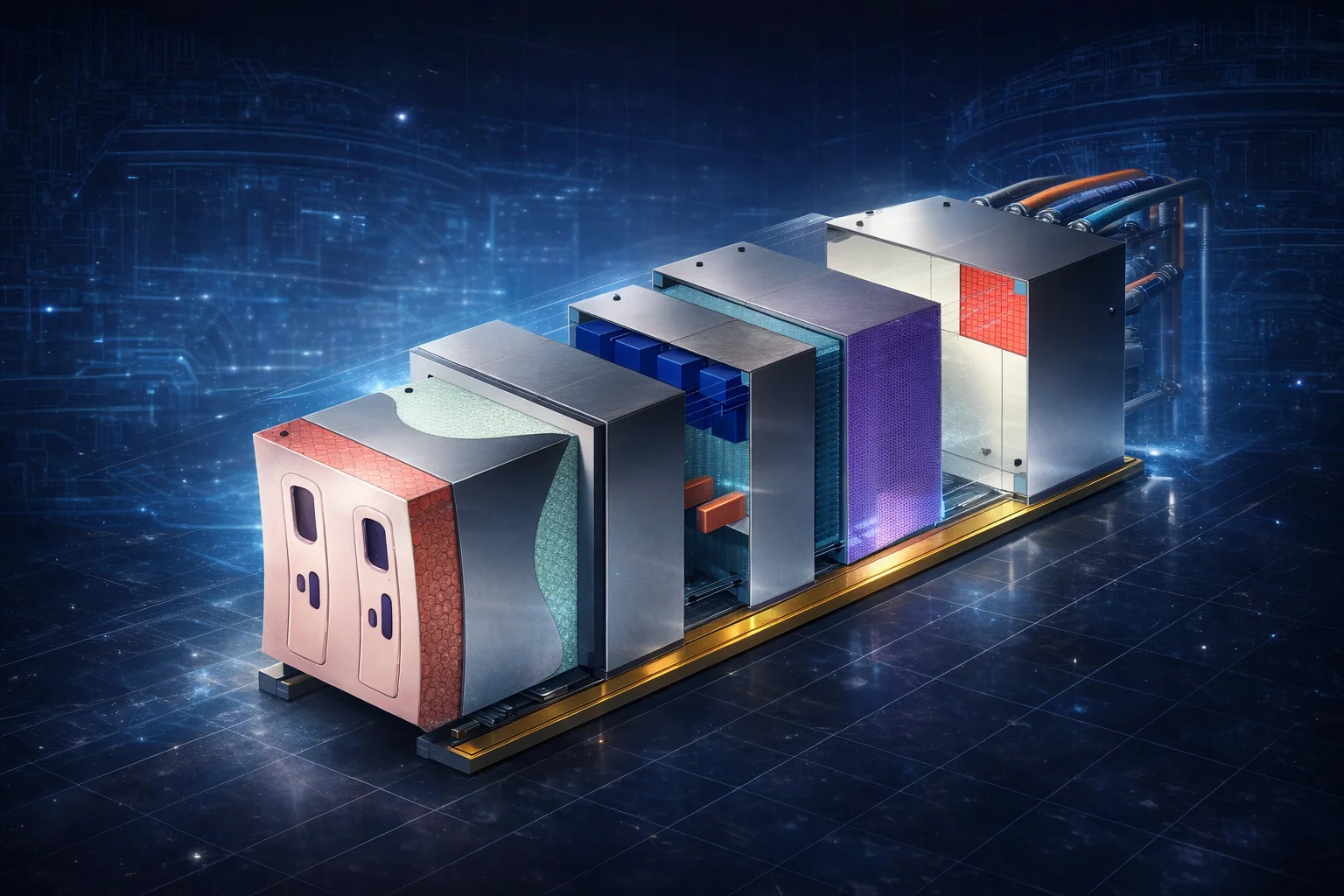
A modular port–plug–based unit consolidating industrial-fusion-relevant measurements into a hot-swappable, factory-qualified assembly. Includes front-end sensors, neutron and gamma shielding, thermal management, and vacuum boundaries — minimalist in footprint, designed for remote handling and maintainability.
Data acquisition
The Versatile Integrated Data Acquisition (VIDA) system provides a unified, fault-tolerant platform covering acquisition boards, industrial chassis, networks, and software for data processing, assimilation, and labeling — standardized across machine types with a common set of variables describing plasma and plant parameters.
Real-time processing
A hybrid architecture combining model-based and machine-learning methods for real-time plasma state reconstruction and uncertainty quantification. Model-based techniques enforce physical constraints and reconstruct missing data; ML methods handle plasma complexity, accelerate simulations, and support continuous learning across machines.
Supply chain ready
Designed from the ground up around standardized, off-the-shelf, fast-replaceable components. Our development roadmap includes forging a dedicated supply chain of diagnostic manufacturers, electronics suppliers, and radiation-hardened systems partners — ensuring controlled costs and stable availability at scale.
MDP Implementation Roadmap
To develop the best solution for the next generation of MCF devices and future fusion power plants, we use a step-by-step approach, starting from developing a quick prototype solution for the current generation of devices that will prove the product idea and demonstrate our ability to execute. For the commercial product, we believe in engaging MCF builders early — to ensure plasma control and device safety are built in from the start, with diagnostics designed for cost efficiency and operational simplicity.
Measurements clarification
Feasibility study
Solution design
Manufacturing & procurement
Deployment & commissioning
Operation & support
Relevant Reading
From standardized diagnostics hardware to real-time plasma state classification — our work spans the full diagnostics pipeline for next-generation MCF devices and future fusion power plants.
Plasma confinement state classification in fusion power plants: Profile reflectometer and ensemble diagnostics
Classifying plasma confinement states in fusion power plants using profile reflectometer and ensemble diagnostics, targeting reliable real-time monitoring without invasive measurements.
Blog ↗How to Measure Plasma — Part II: Control Confidently Despite Imperfections
How to build reliable plasma control on top of imperfect diagnostics — covering uncertainty quantification, ML cross-diagnostic fusion, synthetic diagnostics, data assimilation, and model predictive control strategies for FPPs.
Blog ↗How to Measure Plasma in Fusion Power Plants — Part I: Diagnostics
An introduction to the plasma measurement challenge in future fusion power plants — which diagnostics survive the neutron and thermal environment, what they can measure, and why a minimal but robust set is the only viable path forward.
Paper ↗Plasma confinement state classification via FPP relevant microwave diagnostics
Classifying plasma confinement states using fusion power plant-relevant microwave diagnostics, enabling real-time monitoring without direct profile measurements.
Paper ↗Reconstructing the plasma boundary with a reduced set of diagnostics
Feasibility study for real-time LCFS reconstruction in DIII-D using neural networks trained on minimal diagnostic inputs — coil currents alone achieve 4 cm mean accuracy, demonstrating ML viability in the data-limited environments expected in FPPs.
Blog ↗NSFsim: Validation and verification of synthetic magnetic diagnostics
Collaboration with the DIII-D National Fusion Facility — validating NSFsim's synthetic magnetic diagnostics against experimental data and GSevolve simulations across five plasma configurations.
Solution brief ↗Modular Diagnostics Platform for next generation of MCF devices and future fusion power plants
Our modular diagnostics platform — from port-plug hardware and the VIDA data acquisition system to real-time plasma state reconstruction, designed for next-generation MCF devices and future fusion power plants.
See the publications page to learn more about our research and work.
Building a New Device?
Talk to the MDP team early — the best time to think about diagnostics is at the design stage, not after construction.
Get in touch