Integrated Modeling Framework
The validated simulator behind our integrated modeling framework, for tokamak design, scenarios, disruptions, and operations.

What it is
NSFsim is the core of our integrated modeling framework: a fast, self-consistent solver for 2D free- and fixed-boundary equilibria coupled to 1D transport. Originally based on DINA, one of the key simulation codes used at ITER, it has evolved into a substantially redesigned and extended platform, with a fully rewritten Modern Fortran core, C and Python layers, improved numerical algorithms, and expanded physics capabilities. It is IMAS-compatible and configurable from lightweight control-oriented setups to high-fidelity integrated simulations.
What you get
- Five core modules: forward, inverse (static and time-dependent), disruption, EdFIT reconstruction, and no-plasma
- Breakdown and burn-through to ramp-down; disruptions, VDEs, halo currents, and electromagnetic loads
- Coupled with TRAVIS, ASCOT5, TGLF, MISHKA, TORIC, Aurora/STRAHL, SOL Box Model, a 3D structures solver, etc.
- Bit-exact checkpoint and restart: branch any run from a saved step and replay it exactly
- Upcoming: scenario limits (with Columbia Engineering), 2D–3D coupling for halo currents and EM loads, and more
How it works
Start from physical profiles or diagnostic data (TS/ECE, CXRS, MSE), not mathematical surrogates. Run free- or fixed-boundary, switch modes mid-calculation, and branch any discharge from a checkpoint. Configure the same core for fast control studies or full integrated runs. We can do the work for you, or provide NSFsim as a local installation or a web API.
Proof
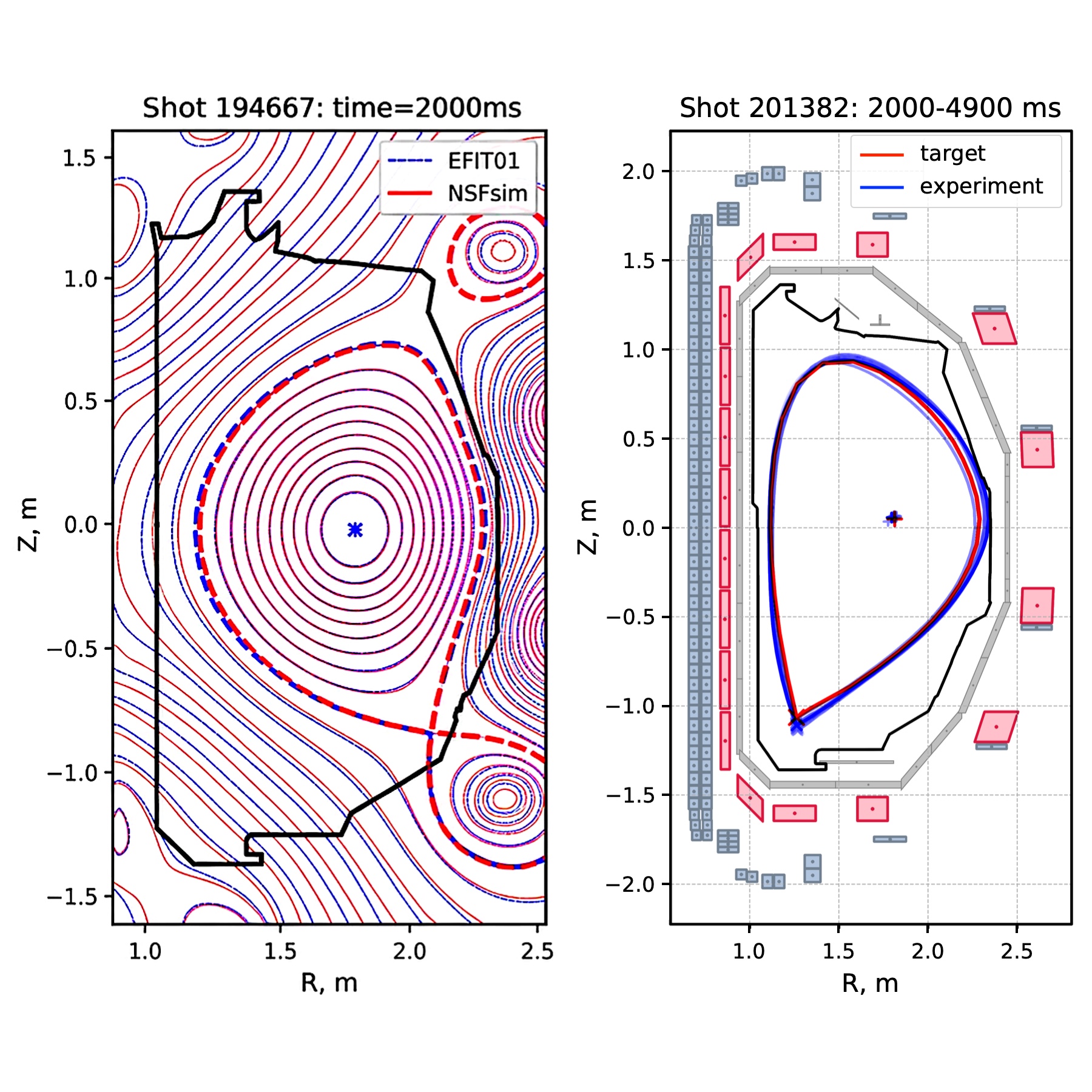
At DIII-D, NSFsim is validated in five plasma shapes, including negative triangularity, against measured signals, EFIT, and GSevolve. It trained the deep RL controllers that ran on the live tokamak, reaching target parameters from the first discharge without tuning. Its shape agent, trained on 120 DIII-D shapes, reaches a mean shape error of 2.01 cm with 30% of sensors masked. It was demonstrated in DTT disruption studies and is applied in feasibility studies and tokamak design projects such as NSF NTT, and at DANTE Fusion, where we lead all design activities on the neutron-source tokamak for medical isotope production.